
When David
becomes Goliath.
Siri, Apple Intelligence, and the changing relationship between Apple and the people who believe in it.
Abstract
Apple’s delays in delivering a more personal Siri are significant for reasons that extend beyond software schedules. The company has cultivated a relationship in which product design, advertising, and leadership narratives invite customers to associate Apple with human agency, creative confidence, and relief from technological complexity. When purchasing expectations precede usable capability, the resulting disappointment can challenge that relationship itself.
This article examines Siri’s origins, the Apple Intelligence rollout, Apple’s changing leadership, and the evolution of its brand promise. It argues that the customer’s strongest claim is not a demand for instant perfection. It is a demand for correspondence between promotional confidence, actual availability, and dependable everyday usefulness. The David-and-Goliath metaphor captures a reversal: a company long associated with challenging established power now exercises substantial control over the experience of individual customers. Siriology.com’s proposed role is to make those customers’ experiences more visible, comparable, and useful—while preserving fair scrutiny, openness to improvement, and the distinction between advocacy and evidence.
Scope and method. This is a qualitative synthesis of public announcements, historical records, selected reporting, and commentary, supplemented by a customer’s reported waitlist experience and supplied satirical artwork. It is not peer-reviewed research, a representative survey, an original performance benchmark, or an investigation based on confidential Apple sources. References appear at the end. Statements about stakeholder incentives and emotional reactions are interpretations unless explicitly attributed. Availability is a snapshot checked September 20, 2026.
The emotional promise behind the purchase
A phone can satisfy a specification and still disappoint the person who bought it. The missing element may be a capability, but it can also be the future the customer expected that capability to make possible: fewer interruptions, less searching, more independence, or a simpler way to get through the day. Apple’s distinctive strength has been its ability to connect technical products to those personal possibilities.
The early personal-computing culture around the Homebrew Computer Club placed knowledge and experimentation within the reach of individuals. Wozniak’s participation belongs to that history. Apple translated some of that energy into commercial products. The relationship between sharing a technical possibility and packaging it for wider use is an enduring tension in the company’s identity.1
In the 1984 Macintosh advertisement, a lone challenger disrupted an image of regimented conformity. The advertisement offered a cultural position before explaining a computer. Think Different later associated Apple with unconventional creators; participant Rob Siltanen’s account also reminds us that the campaign emerged from collaborative agency work rather than a single founder’s inspiration. The Get a Mac campaign gave the competing platforms personalities, making ease and awkwardness emotionally recognizable.2–4
These campaigns can be read as invitations to identify with the capable outsider. That is an interpretation of their imagery and structure, not evidence that every customer experienced them identically. Their relevance to Siri is the standard they help establish: the computer should reduce the distance between human intention and useful action.
Product introductions made that standard concrete. Apple’s 2001 iPod announcement translated storage into the prospect of carrying a music collection. Its 2007 iPhone announcement combined phone, music, and internet functions around an integrated touch interface. The argument was about a different experience of familiar activities, not just a list of internal components.23, 24
Packaging and presentation participate in that promise. A deliberately paced reveal, a comprehensible interface, and an object that feels considered can suggest that the company has done the difficult work on the customer’s behalf. This article treats that suggestion as an emotional contract, not a legal one. Its strength is cumulative: past satisfactory experiences encourage the customer to trust a new demonstration before independently verifying every detail.
There is a corresponding vulnerability. If the sale is emotionally complete while the experience remains materially incomplete, the customer can feel that the confidence of the presentation exceeded the confidence justified by the product. A waitlist is therefore part of the product experience. So are setup requirements, regional exclusions, usage limits, and explanations of what happens next. They are not outside the brand merely because they appear after the keynote.
Apple and its leaders as reflections of one another
It is tempting to arrange Apple’s history into a simple morality play: Wozniak as generous engineer, Jobs as visionary, Cook as operator, and Ternus as the hoped-for restoration of engineering. Such portraits contain recognizable emphases, but they obscure collaboration and encourage claims about motives that public evidence cannot establish.
Wozniak’s significance is a reminder that technology begins with the pleasure and discipline of making something work. Jobs’s significance includes recognizing that technical possibility must become an experience another person can understand. Neither impulse is sufficient alone. An elegant demonstration without dependable engineering is fragile; excellent engineering without an intelligible human purpose may struggle to matter.
The Steve Jobs Archive documents a career extending through Apple’s early years, NeXT, Pixar, and the return to Apple. It records a person who revised ideas, worked through setbacks, and depended on other people. The archive is a curated collection rather than an exhaustive biography, but it makes the image of an unchanging, solitary genius difficult to sustain.22
Jobs’s 2005 Stanford address is useful on precisely this point. He linked an apparently impractical interest in calligraphy to the Macintosh, described losing his Apple role as part of a later creative renewal, and framed mortality as a reason to choose meaningful work. These are his retrospective interpretations of his life. Their relevance here is the importance he assigned to learning from experiences whose value was not immediately apparent.5
The 1997 Microsoft agreement illustrates strategic revision in public. At Macworld, Jobs announced cooperation with a company many Apple supporters treated as an adversary; Gates appeared remotely by satellite. The agreement included future Mac software, patent arrangements, and a $150 million investment in non-voting Apple stock. It should not be reduced to the myth that a single payment independently rescued Apple.6, 7
The deeper lesson is that customer benefit can require challenging the company’s own tribal story. Jobs could defend Apple’s distinctiveness while recognizing that common customers needed cooperation. His 1997 argument for working backward from customer experience reinforces the same discipline: organizational pride must answer to the user’s actual needs.8
Cook’s record also resists a one-dimensional interpretation. His 2016 customer letter made privacy and security a visible institutional commitment. The 2020 introduction of M1 Macs demonstrated substantial integration of hardware and software during his leadership. These examples do not settle every criticism of the era, but they undermine the idea that operations and product ambition are necessarily opposites.9, 10
Apple’s April 2026 succession announcement named John Ternus CEO effective September 1, with Cook moving to executive chairman. Ternus’s engineering background gives observers one reason to watch execution closely. Yet attributing an inherited Siri program’s immediate successes or failures solely to a newly installed leader would confuse an announcement date with years of organizational work.11
The meaningful continuity test is behavioral. Does leadership align the announcement with product readiness? Does it explain uncertainty before the customer pays? Does it acknowledge a failure in terms meaningful to the person affected? Invoking Jobs’s standards is useful when it clarifies those questions; it becomes unhelpful when it substitutes imagined answers from a deceased founder for evidence.
Siri’s ambition was always larger than a voice
Siri’s research roots extend into SRI’s work on intelligent assistance, including the CALO project within DARPA’s PAL program. SRI spun out Siri in 2007; Apple acquired it in April 2010 and introduced it as part of the iPhone 4S in October 2011. Thus the acquisition was sixteen years before this article, not more than twenty; the underlying research lineage is older.12
Apple’s 2011 announcement described an assistant that could respond to ordinary requests involving communication, reminders, and information. The consequential idea was a change in the interface: say what you want, rather than navigate every step yourself. Siri’s identity was therefore tied to accomplishing a purpose from its first Apple presentation.13
This distinction matters because conversation and assistance are not identical. A system can produce a pleasant answer without completing a task. Conversely, a simple command system can be valuable without having an impressive conversation. The customer’s expectation becomes harder to satisfy when one familiar name appears to promise both.
Competition broadened the reference point. Amazon’s 2014 Echo announcement brought a voice-controlled assistant into a dedicated home device. Later, ChatGPT’s November 2022 research preview offered a conversational system able to sustain dialogue, while its own launch description acknowledged limitations including plausible but incorrect answers. These products did not solve the same problem in the same way; they expanded the kinds of interaction people could experience and compare.27, 26
That comparison can be psychologically powerful even when it is technically imperfect. A person may ask why a separate AI tool can discuss a complicated subject while a device assistant struggles with a practical request. A fluent answer is not proof of dependable device control, but the visible contrast can still reset expectations. Apple must explain the difference without asking customers to become systems engineers.
Siri Shortcuts, introduced with iOS 12 in 2018, expanded the ability to invoke app actions and routines. That was genuine development. Yet a configured workflow and a flexible assistant interpreting an unfamiliar goal place different demands on the user. The unresolved ambition has been to move more of that coordinating work from the person to the system.14
What Apple promised—and what arrived
Precision is essential to a strong critique. Apple Intelligence is an umbrella for multiple capabilities. “Siri” also spans existing functions, interface changes, language improvements, and more ambitious personal assistance. Saying that nothing shipped would erase real releases. Saying that Apple Intelligence shipped does not establish that the particular feature motivating a purchase was ready.
| Milestone | Documented position | Customer significance |
|---|---|---|
| June 2024 | Apple introduced personal context, onscreen awareness, and expanded app actions within a phased Apple Intelligence rollout.15 | A vision of the complete experience was visible before all its parts were available. |
| October 2024 | The first release included Writing Tools, photo features, and Siri improvements; deeper personal capabilities remained forthcoming.20 | First availability and completion of the vision were different milestones. |
| March–June 2025 | A personalized Siri delay drew criticism; executives subsequently acknowledged shortcomings in the initial approach.16, 21 | The delay affected confidence in earlier promotion as well as the schedule. |
| June 2026 | Apple introduced Siri AI, with developer testing and a consumer beta planned later that year.17 | A preview was not a promise of immediate access for every buyer. |
| September 14, 2026 | Apple announced an English-language beta rollout with availability qualifications and limits.18 | A release announcement still required checking individual eligibility and access. |
The 2024 announcement did contain phased-availability language. It would therefore be unfair to claim an unqualified promise that everything would work on day one. The more defensible criticism concerns the relationship between the most persuasive demonstrations and the readiness of those particular functions. A buyer may remember the personal outcome more vividly than the qualification surrounding its delivery.
The customer experience motivating this project is specific: the site’s creator reports upgrading to an iPhone 18 Pro Max partly for Siri AI and then encountering a waitlist. This account explains the inquiry. It does not establish an average waiting period, the cause of his queue position, or the experience of all owners.
Apple’s September announcement says Siri AI is rolling out in beta in English, notes initial regional restrictions, and describes variable daily limits for certain server-based features. It also says expanded access to such features will be offered for a fee in the future. The cited announcement does not establish the eventual price or any particular customer’s wait duration.18
For a buyer, the resulting questions are straightforward: Does my device qualify? Can I use the feature in my region and language? Is access enabled now? What limits apply to the task I bought it for? What might cost extra later? These questions should be easy to answer before a purchase, even where Apple cannot responsibly predict a precise individual activation time.
In April 2025, the National Advertising Division recommended modifying or discontinuing certain availability claims for Apple Intelligence. Apple disagreed with the findings but said it would follow the recommendations. This was advertising self-regulation, not a court judgment establishing fraud. Its relevance is the concern that prominent availability language and its qualifications should leave a clear overall impression.19
Technical difficulty explains the challenge, not every decision
In reporting on a June 2025 interview, The Verge described Craig Federighi acknowledging that Apple’s initial attempt at the upgraded Siri did not meet its quality requirements. That is attributable evidence that reliability was a problem. It does not independently reveal every internal decision or establish which team, executive, or incentive caused the delay.21
Apple’s June 2026 architecture description combines models running locally and through Private Cloud Compute with on-device indexing and action capabilities. This is Apple’s account of the system, not an independent security audit or proof of performance across all tasks.17
The product challenge can nevertheless be explained without pretending to know confidential details. Consider a request to send the correct document to the correct person. The assistant must interpret the request, distinguish similar people and files, determine permissions, carry out the action, and communicate the result. An error at any stage can invalidate an otherwise fluent interaction. This is an illustrative task analysis, not a claim about Siri’s exact implementation.
Personal context raises the stakes because the information is intimate and the requested actions may have consequences. Greater access is not automatically better assistance. A useful assistant must give the user an understandable relationship between permission, capability, confirmation, and recovery when something goes wrong.
Apple therefore has a legitimate reason to avoid releasing unreliable automation. But there are two separate responsibilities: deciding whether a system is ready and deciding how confidently to market it before it is ready. A defensible delay can coexist with a poorly calibrated promise. Explaining the former does not resolve the latter.
Nor can privacy, by itself, settle the argument. Privacy is a product value that can justify constraints. It is not evidence that every shortcoming arises from protecting users, or that every more capable competitor is careless. Those are empirical questions requiring specific evidence. The customer deserves both a trustworthy system and an honest account of its limitations.
Why the same delay means different things
The following analysis identifies plausible concerns, not uniform beliefs or hidden motives. “Apple users,” “the media,” and “investors” are not single minds. People can hold several positions at once: appreciate the hardware, value privacy, dislike the marketing, and still hope the assistant succeeds.
| Perspective | What is at stake | What would build confidence |
|---|---|---|
| Everyday customers | Time, purchase value, accessibility, and predictable help. | Clear availability and reliable completion of useful tasks. |
| Longtime advocates | Trust in Apple and confidence in recommendations made to others. | Candid acknowledgment of gaps and visible follow-through. |
| Apple leadership | Product reputation, competitive relevance, and execution. | Promises matched to readiness and measurable customer benefit. |
| Engineers and developers | Reliability, integration, realistic scope, and maintainable systems. | Stable interfaces, informative failures, and credible delivery priorities. |
| Media | Verification and explaining the difference between demonstration and use. | Independent hands-on access and reproducible evidence. |
| Investors | Adoption, retention, costs, and durable commercial value. | Evidence that useful experiences sustain demand beyond launch attention. |
A longtime advocate may experience a failure as more than inconvenience. Recommending a product puts personal judgment into circulation. If someone persuaded family members to upgrade or defended Apple’s approach, a missing feature can make that person feel exposed. This is a proposed explanation of why disappointment can be intense; this article has not measured how common it is.
There is also an asymmetry in accumulated trust. Years of good experiences can encourage patience, but they can increase the expectation that Apple will be unusually careful with a promise. Loyalty may initially buffer disappointment and later amplify it. The relationship can move from “they will get this right” to “they knew people trusted them.” Neither reaction proves deception. Both make communication consequential.
John Gruber’s March 2025 criticism is a useful documented example. He questioned the evidentiary basis for the personalized Siri presentation and described his own earlier confidence as misplaced. His commentary matters as a prominent Apple-focused writer’s reassessment. It cannot stand in for a poll, nor should his strongest characterizations be silently converted into established facts.16
Journalists face a related problem: access to a carefully prepared demonstration is evidence of something, but not of everything the customer will encounter. Investors face another: an attractive AI narrative can suggest future value before the daily use justifying that value is established. Those incentives do not prove bad faith. They make independent evaluation particularly useful.
The customer’s perspective supplies a practical discipline to all of them. A feature’s significance is not exhausted by its announcement, novelty, technical ambition, or commercial potential. It must eventually do something worthwhile for a person under ordinary conditions.
The challenger has become the gatekeeper
Apple’s underdog imagery offered customers a compelling role: choosing the product could feel like siding with individual imagination against institutional conformity. That story remains emotionally resonant even when the relationship between the company and a particular customer is highly unequal.
Apple determines the release process, supports the software, sets the product’s terms, and controls much of the explanation surrounding access. The individual buyer can ask, wait, complain, or choose alternatives, but cannot negotiate most of those conditions. In this relationship, describing the customer as David and Apple as Goliath is a metaphor for unequal influence.
The metaphor does not require depicting Apple as evil. It asks whether an institution that celebrates the independent thinker will make room for independent judgment directed at itself. A brand cannot coherently reserve critical thinking for the moment a person chooses it and then treat criticism after purchase as disloyalty.
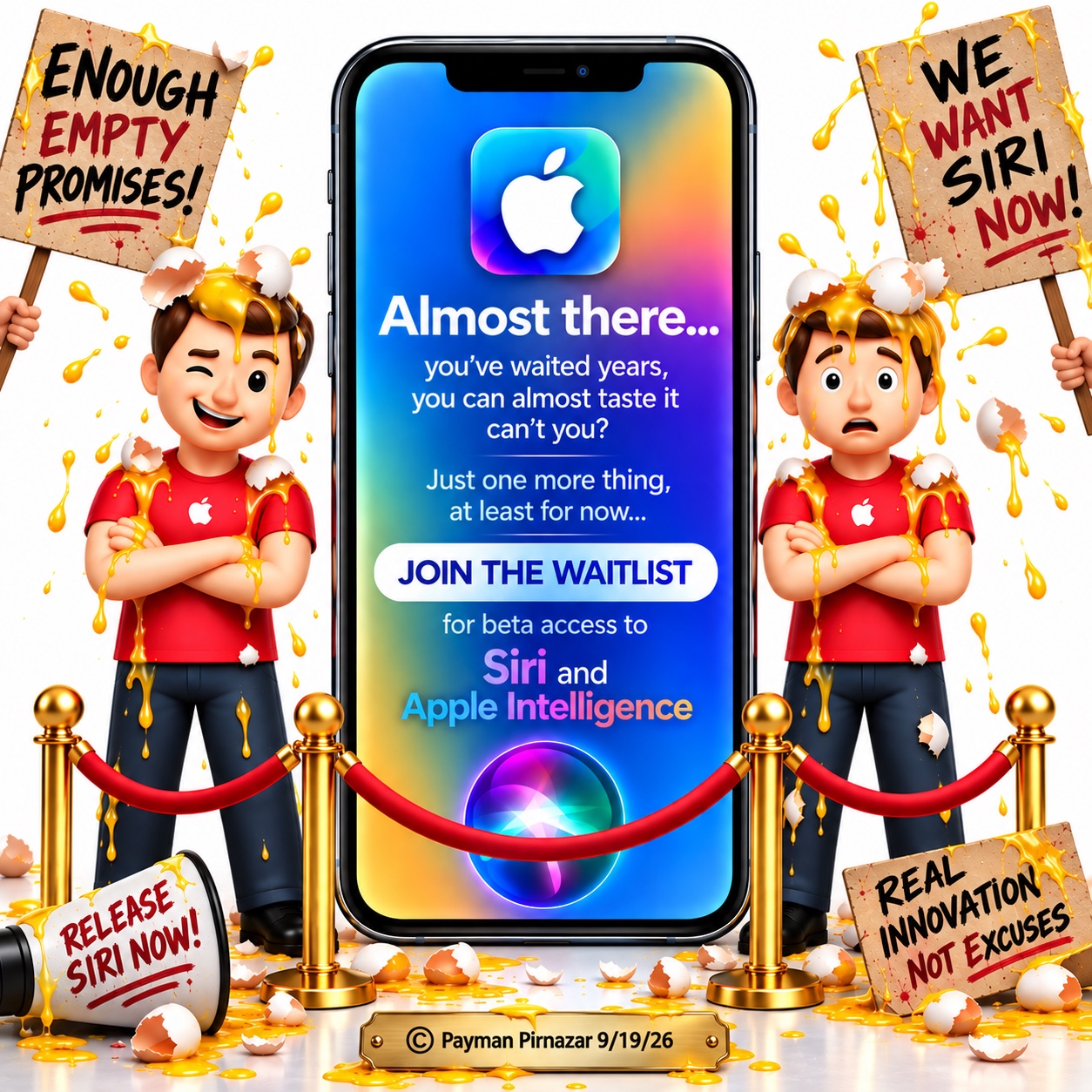
The supplied artwork compresses that reversal. A luminous product occupies the center while the people who want it remain behind a rope. Protest signs reject the indefinite invitation. The egg imagery can be read as humiliation, defiance, or embarrassment on behalf of believers. Its force is emotional and satirical, not statistical.
The company that invited us to think different should welcome us thinking critically about it.
There is a limit to the metaphor: this need not end with one side defeating the other. Customers generally benefit when tools improve. Apple benefits when people trust, use, and recommend them. The productive objective is to make an unequal relationship more responsive, not to confuse mutual dependence with equal power.
A customer’s leverage is modest alone but can become more legible when experiences are documented coherently. Collective attention can identify recurring problems, ask consistent questions, and support informed purchasing. It cannot guarantee that Apple changes a decision. Empowerment should explain real avenues of influence without promising control that a community does not possess.
Partnership must mean more than patience
Calling customers partners is meaningful only if the word clarifies both contribution and responsibility. Purchases sustain commercial development. Actual use exposes the distance between a prepared demonstration and a messy day. Recommendations help establish a product’s reputation. None of that turns the buyer into a legal owner of the product roadmap.
Apple has itself made customer creativity part of its public story. The 2019 Shot on iPhone Challenge invited users to submit photographs for prominent display. It provides a concrete example of customers contributing visible evidence of a tool’s value. The broader lesson is that a technology’s cultural significance is partly made by what people do with it.25
Yet participation must remain voluntary. An AI product should not transfer its quality obligations to buyers by celebrating them as a community. Customers may choose to test a beta, report an issue, or develop a workflow. They may equally choose to expect a useful product without undertaking unpaid troubleshooting.
A reciprocal relationship would include five commitments. First, explain availability where a purchasing decision occurs. Second, distinguish a demonstration from an independently usable feature. Third, explain important limits before they interrupt a task. Fourth, acknowledge changed expectations directly. Fifth, show how feedback informs priorities without implying that every request will be implemented.
Customers have corresponding opportunities rather than obligations: judge purchases by present utility; describe failures accurately; distinguish a personal experience from a population-wide claim; recognize improvements; and retain the freedom to use competing tools. Constructive criticism need not become brand hostility, and appreciation need not become automatic defense.
For the iPhone owner who upgraded partly for Siri AI, this approach also avoids an all-or-nothing judgment of the purchase. The hardware may have other value while the unmet AI expectation remains legitimate. Acknowledging one does not cancel the other.
From shared experience to worthwhile insight
In this project, Siriology is the working name for studying Siri’s promises, performance, and human consequences. No claim is made to having established a new academic discipline or to being the first person ever to use the word. Siriology.com is the proposed editorial home for that inquiry, beginning with Siri and extending to AI’s role in daily life.
Its value should come from the quality of the connection it makes: between a frustrated user and a useful explanation, between an enthusiastic user and a reproducible benefit, between a recurring difficulty and a concrete improvement worth considering. Collecting complaints alone would leave much of that potential unrealized.
Different perspectives belong in the inquiry. A person with accessibility needs may value a function differently from a developer. A multilingual household may discover a limitation absent from an English-only demonstration. A creative professional may find a feature useful but object to the way it is presented. A newcomer may reveal that the explanation, rather than the underlying technology, is the principal obstacle.
The proposed editorial approach is to preserve those differences while organizing the evidence. Each practical account should identify the intended task, relevant conditions, observed result, and remaining uncertainty. Private information should be removed before publication, and participation should not require surrendering intimate data merely to establish credibility.
| Question | What to record | Why it helps |
|---|---|---|
| Can the person access it? | Device, software version, language, region, feature status, and date. | Separates availability from performance. |
| Did it understand? | The request and any clarification needed. | Distinguishes interpretation from execution. |
| Did it complete the task? | The expected outcome, actual outcome, and observable errors. | Tests usefulness beyond fluent language. |
| Was it dependable? | Repeated attempts and the conditions that changed. | Prevents one success or failure from becoming an unsupported generalization. |
| Was it worth using? | Time saved, corrections required, verification effort, and relevant costs. | Relates capability to everyday value. |
| What should happen next? | A qualified workaround, a question, or a specific improvement request. | Turns observation into an actionable conclusion. |
For example, a request to find an appointment in messages might fail because access is unavailable, permission is missing, the request is ambiguous, or retrieval is unreliable. Those possibilities call for different responses. A useful account avoids declaring the whole product broken before establishing what happened.
A summary provides another example. The evaluation should consider whether it preserves consequential details and how much checking it requires. A polished paragraph can still be a poor tool if verification takes longer than reading the original. This is an illustrative criterion, not a measured result for Siri.
Editorial credibility also requires reporting improvements and counterexamples. If a software update resolves a documented failure, the record should say so. If a workaround works only under specific conditions, those conditions belong beside the recommendation. Corrections should be visible. Strong conclusions should follow stronger evidence.
The site’s role is therefore a conduit for accountable learning, not a claim to speak for every Apple customer. It can help readers become better judges of AI and help their observations become more useful to one another—and potentially to the people building the products. Community submission tools and a formal testing program would be future implementations of this mission; this article does not imply they already exist.
Make the experience worthy of the promise
The central issue is not whether difficult technology should ever be delayed. It is whether the relationship between ambition, communication, and delivery respects the person asked to believe. Apple’s history gives that question unusual force because its most persuasive stories have celebrated the individual’s agency.
Siri exposes a demanding version of the same ideal. A useful assistant must do more than appear intelligent: it must help under the conditions in which a person actually needs help. Every gap between invitation and access, capability and reliability, or announcement and explanation becomes part of the customer’s experience.
The customer as David is not powerless. The ability to ask precise questions, share evidence, compare alternatives, and decide where to place future trust has real value. Siriology’s task is to make those choices better informed and those experiences more useful.
Apple’s customers helped give its products meaning. Their voice belongs in the next chapter—not because they can dictate every engineering decision, but because their lives are where the promises must ultimately work.
Limitations and open questions
This article does not establish how many customers share the originating experience, how long a typical wait lasts, the comparative accuracy of competing assistants, or the internal allocation of responsibility for Siri delays. A representative survey, independently repeated task tests, and further attributable reporting would be needed to answer those questions. Apple’s announcements are evidence of its stated position; they are not independent validation of outcomes. Historical accounts and commentary have their own perspectives. The analysis should be revisited as capabilities, access, pricing, and public evidence change.
References &
source notes.
Numbered citations connect the article to these sources. Primary announcements establish the company’s stated position; reporting and historical commentary are identified separately. Interpretations and proposed evaluation criteria are this article’s analysis.
Research checked September 20, 2026. This is a dated essay, not a live availability tracker.
- WIRED — The Homebrew Computer Club
Historical context for Wozniak, sharing, and the personal-computer movement.
- WIRED — Dawn of the Mac
The 1984 advertisement and its introduction of Macintosh.
- Rob Siltanen, Forbes — The real story behind Think Different
2011 participant account; the campaign was a collaborative creative effort, not Jobs’s work alone.
- Get a Mac — campaign overview
Secondary reference for the recurring Mac and PC characters; the brand interpretation here is editorial.
- Stanford — Steve Jobs’s commencement address
June 12, 2005. Official transcript: connecting the dots, love and loss, and mortality.
- Microsoft — Apple and Microsoft agreement
August 6, 1997. Primary announcement of software commitments and investment.
- WIRED — Apple and Microsoft’s 1997 rapprochement
Retrospective on Gates’s satellite appearance and the audience response.
- Daring Fireball — Working Backwards
Jobs’s 1997 customer-experience argument, with video reference.
- Apple — A message to our customers
Tim Cook’s 2016 statement on security and privacy.
- Apple — Introducing the next generation of Mac
November 2020. The M1 transition under Cook.
- Apple — Leadership succession
April 20, 2026. Ternus’s appointment, effective September 1, and Cook’s executive-chairman role.
- SRI — Siri’s origins
Research roots, the 2007 venture, and Apple’s April 2010 acquisition.
- Apple — iPhone 4S, iOS 5 & iCloud
October 4, 2011. Siri’s introduction on iPhone and original use cases.
- Apple — iOS 12 preview
June 2018. Siri Shortcuts and app integrations.
- Apple — Introducing Apple Intelligence
June 10, 2024. Personal context, onscreen awareness, app actions, and phased availability.
- John Gruber — Something Is Rotten in the State of Cupertino
March 12, 2025. Commentary on the personalized Siri delay and Apple’s credibility.
- Apple — Introducing Siri AI
June 8, 2026. WWDC capabilities, architecture, and planned beta.
- Apple — Siri AI is here
September 14, 2026. Beta rollout, eligibility, regional restrictions, daily limits, and planned paid expanded access. No individual waitlist duration is established.
- BBB National Programs — Apple Intelligence availability claims
April 22, 2025. Advertising self-regulatory recommendation, not a court judgment.
- Apple — Apple Intelligence is available today
October 28, 2024. Primary release announcement, separating the first features from capabilities still forthcoming.
- The Verge — Craig Federighi confirms Apple’s first attempt at an AI Siri wasn’t good enough
June 2025. Reporting on executives’ public explanation of reliability shortcomings. It does not independently establish every internal cause.
- Steve Jobs Archive — Make Something Wonderful
Curated primary speeches, interviews, and correspondence, edited by Leslie Berlin. Read as a selected record, not a complete biography.
- Apple — Apple Presents iPod
October 23, 2001. Primary announcement framing technical capacity as a portable music experience.
- Apple — Apple Reinvents the Phone with iPhone
January 9, 2007. Primary announcement of the integrated phone, music, internet, and touch experience.
- Apple — Share your best photos shot on iPhone
January 22, 2019. Primary example of customer creative work contributing to Apple’s public product story.
- OpenAI — Introducing ChatGPT
November 30, 2022. Primary research-preview announcement, including acknowledged limitations. Not a comparative benchmark.
- TIME — Amazon Unveils Siri-Like Speaker You Control With Your Voice
November 6, 2014. Contemporary reporting on the Echo introduction. Used for historical competitive context, not present-day product specifications.